A researcher at Birmingham City University, School of Art (2002-2018), Françoise Dupré lead a series of collaborative-participatory projects through which she developed her socially engaged practice, working in a wide range of cultural and social and international contexts. Self-initiated or commissioned, these projects are here introduced and archived.
Dupré’s collaborative and participatory practice began with her involvement with Feminist Art projects in Britain in the 80s and 90s. Her practice is underpinned by a strong belief in art as a transformative and empowering force for change. A conviction that also grew from her experience, when as a young artist she worked on local community art projects, principally in South London where she lived.
DORA PROJECT, 2015-2016
Directed by Françoise Dupré, in collaboration with artist Rebecca Snow, DORA PROJECT centered around WW2 London and V2 victims. They were Londoners and Mittelbau-Dora concentration camp prisoners who assembled the V2s in Germany. The cross-generational archiving and participatory project addressed, through art, the contemporary relevance of the history of World War Two and early rocket engineering.
For more details, visit project website: dora-project
St Alfege Millennium art project, 2009-2012
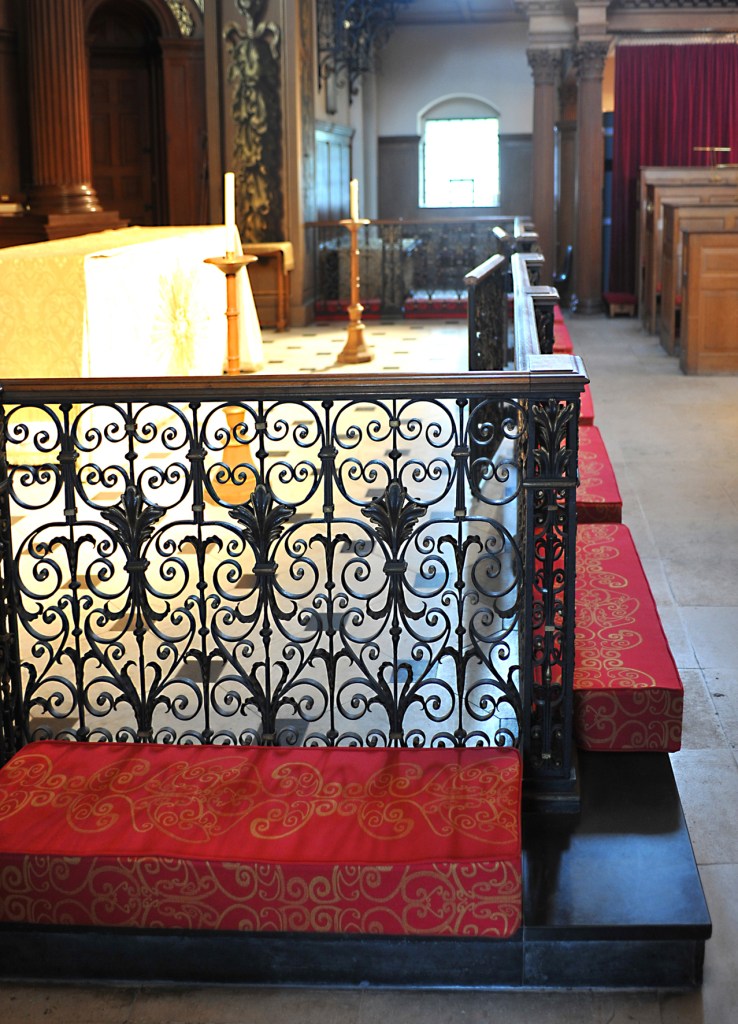
The Royal Parish Church of St Alfege in Greenwich, London, invited Françoise Dupré to celebrate the 2012 St Alfege Millennium. Inspired by the designs of Jean Tijou (- 1712) for the church ironwork, the artist led a community art project to research and develop ideas for a new artwork.
Dupré made a series of drawings from which textile designs were created. Sylvia Young, fashion designer and congregation member, worked with fabric manufacturer Henry Bertrand, to produce samples from which the congregation chose their favorite. The final outcome was new pew and altar cushions for the Church – joining function and creativity.
The congregation covered the manufacturing cost of fabric and cushions. The pilot project was supported by St Alfege Parochial Church Council, Sir William Boreman’s Foundation, Greenwich Charities and sponsored by Pony Needle Industries (India) Private Limited.
Right: St Allege Royal Parish Church. Photo © Françoise Dupré

Designer: Simon Meddings Associates, editors: Guy Burch and Françoise Dupré
Brixton Calling! 2011
A collaborative and participatory project and an exhibition that connected contemporary Brixton to its past – through the history of 1980s Brixton Art Gallery & Artists Collective and their archives.
The project was a collaboration between 198 Contemporary Art and Learning (director: Lucy Davies and curator: Barby Asante) and BACA (5 individual members of the Brixton Artists Collective: Teri Bullen, Guy Burch, Françoise Dupré, Rita Keegan, Stefan Szczelkun). Françoise Dupré was BACA project manager and co-curator.
Brixton Calling! received funding from Arts Council England and Heritage Lottery Fund. Project partners included: Tate Archive, Tate Britain; Women’s Art Library, Goldsmiths, University of London; Women’s Library, London Metropolitan University; Lambeth Archives, Tate Collective, (formerly known as Tate Forum); The Bodleian Library of Commonwealth and African Studies, Oxford; Burntwood School, Wandsworth. Archive materials, ephemera and records gathered during Brixton Calling! were deposited in London at Tate Archive (TGA 201211), Women’s Art Library, Hall Carpenter Archive (LSE) and Lambeth Archives.
For more details about Brixton Calling! do check: Brixton Calling! project booklet and text by Guy Burch and Françoise Dupré in engage Journal 3, 2012, Case Study:Brixton Calling! Reclaiming the Past in the Present
For more information about Brixton Art Gallery do visit: Andrew Hurman’s website http://brixton50.co.uk Text by Françoise Dupré in Brixton 50, 2008, Brixton Art Gallery, Brixton Artists Collective, Women’s Work -A personal account.

Photo by Daniel (Oral History group) Icha Muhammad.
emplacements, 1997-2003
An international artist-led cross cultural and trans-national project. Initiated in the UK by Françoise Dupré and Roxane Permar in collaboration with Gail Pearce. The outcomes were a series of international events and exhibitions.
Following its first two London events, disEMplacements and relocation in 1999, emplacements realised, in 2000, its first event in St Petersburg, on the historic Navy site of New Holland. In 2002 it returned to the city to develop and realise its second project at the Red Banner Knitwear Factory, a working textile factory on Petrograd Island. Finally, in 2003 emplacements took part in Manchester Week with a collection of simultaneous events that responded to the 300th anniversary of St Petersburg.
Through the years, the emplacements core team developed on going and long-term dialogues and partnerships with UK and Russian institutions, individuals, international artists and curators. emplacementsevolved with St Petersburg rich cultural context, creating a unique and creative experience for all.

The factory’s own power station was designed by German architect Erich Mendelsohn and built in the years 1926 to 1930.
For more details about the project, do check: emplacements-introduction and St Peterburg artist curator Dimitri Pilikin’s account of the Red Banner Knitwear Factory project: emplacements-on-the-red-flag-knitwear-factory

