[haberdashery]
As a child, Françoise Dupré walked with her seamstress mother to the local haberdasheries situated along the fabric shops of Place Saint Pierre in the 18th district of Paris. They bought buttons, dressmaking patterns, threads and zips.
Today, the sewing patterns are stored in her grand-mother suitcase and have become part of the artist’s archive. Made of thin tissue paper, the used patterns are kept neatly folded in their paper sleeves. They recall Paris fashion from the early 50s to the 80s. Some patterns, the artist recalls, were for her own dresses, trousers and swimwear.
Right: Paulette Dupré’s sewing patterns from 1950s to 1980s. Photo © Françoise Dupré Archive


Intrigued by the complexity of the cut patterns and the clever folding technique used for packaging and storing, the artist, spent time unfolding and refolding the fragile pieces of green, yellow or brown paper.
To finally assemble some – pinning or stitching along the printed multi-lingual instruction texts and over the complex diagrams and lines.
Left: Petit pliage, Patron inconnu (papier de soie sans marquage). Wall piece. Sewing pattern paper, embroidery thread, pins. 0m17 H x 0m22 W. Photo © Françoise Dupré

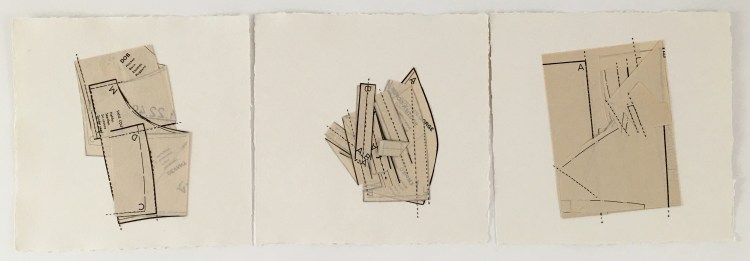
In the series pliage (je serai sage) and (je n’ai rien compris), the artist pays homage to her mother, the maker who deciphered the patterns and transformed flat fabric – a pliable plane (Anni Albers) – into three dimensional garments.
The titles I promise to be good and I understood nothing subtlety allude to mother-daughter relationship and their unspoken yet deeply felt love.
Right: Pliage (je n’ai rien compris) 3, Tunique, pantalon, robe, Patron no9045 (2 pieces).
Wall piece. Sewing pattern paper, embroidery thread, pins. 0m29 H x 0m20 W.
Photo © Françoise Dupré


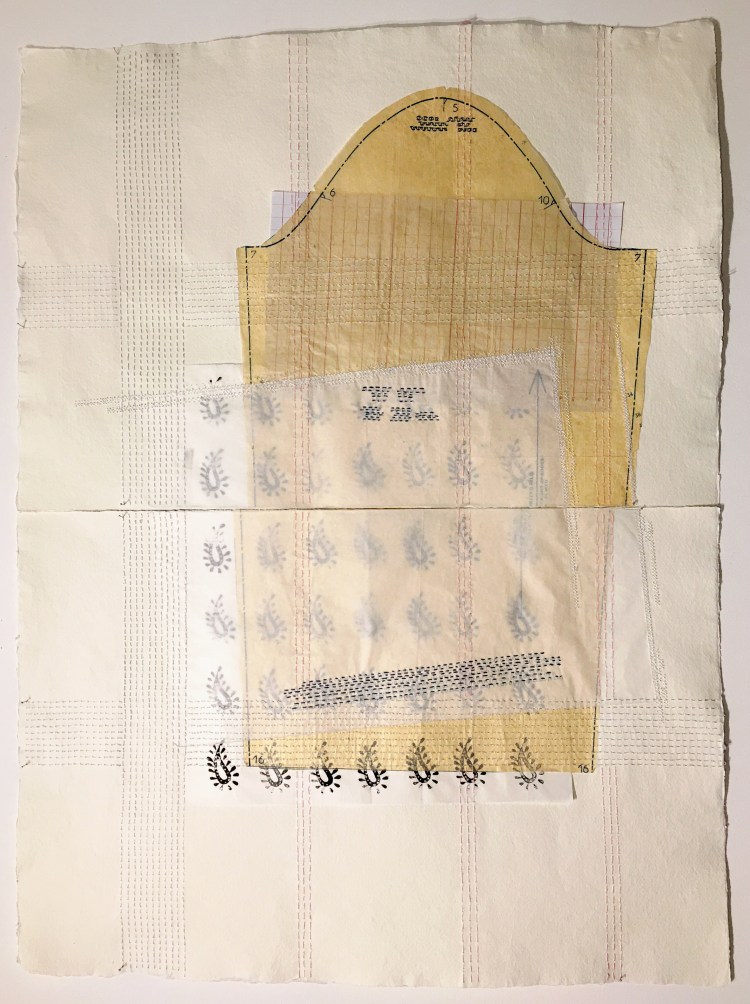
0m56 W x 0m75H. Photo © Françoise Dupré
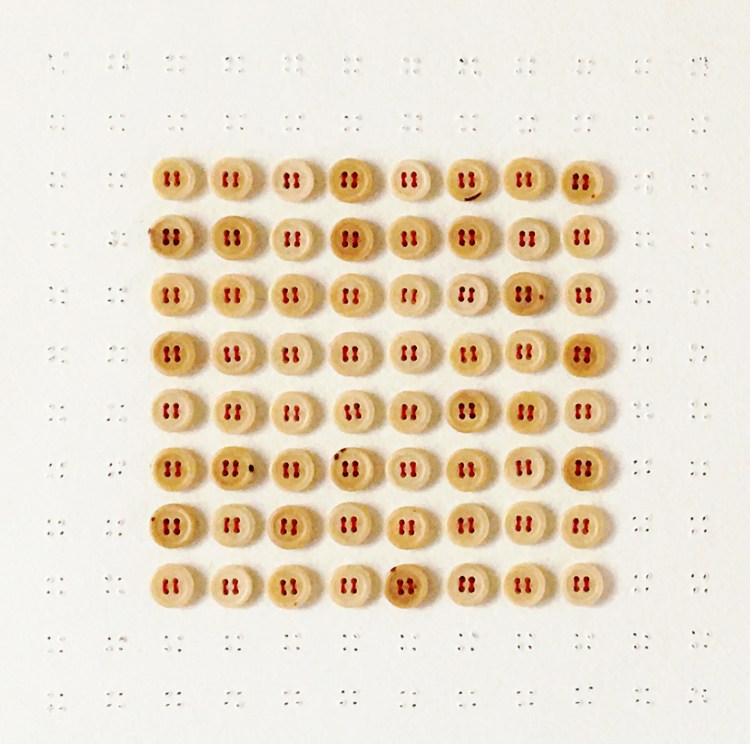
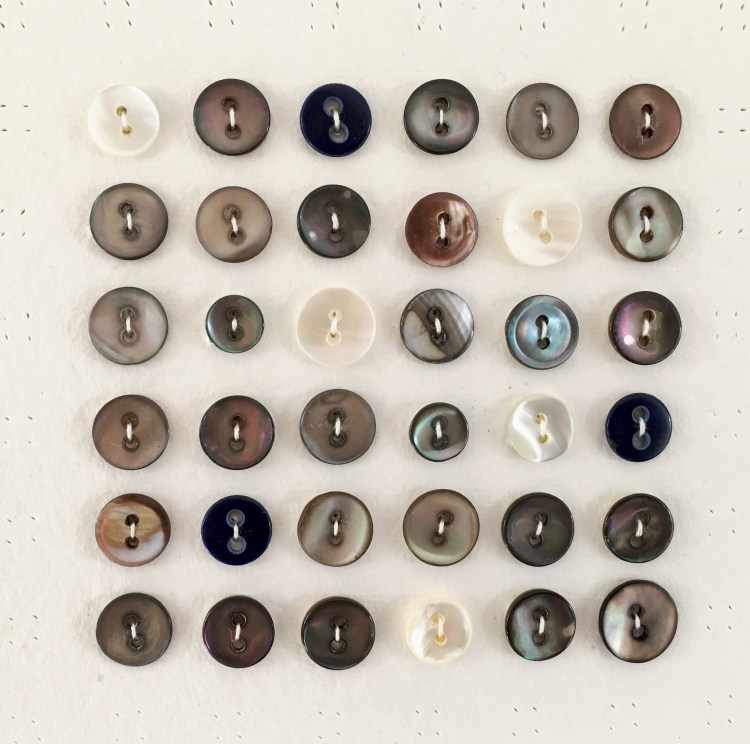
For the series Boutons, the artist opened the tin filled with the family button collection. Organising and stitching buttons on cotton rag paper – in order of colour and fabrication – Dupré created a group of small wall-based pieces, recalling button cards. Seriality was employed to create order from the jumble of buttons and perhaps to distance oneself from their powerful connection to the clothes once wore by family members.
Dupré employed the same grid design as one used in the red cross-stitched marking series, shown on the fil rouge page. The use of “the grid and its intersecting opposite lines” is after all the means through which one designs a weave [or cross stitches an abecedary]. Catherine de Zegher, Eva Hess in women’s work is never done, 2014.
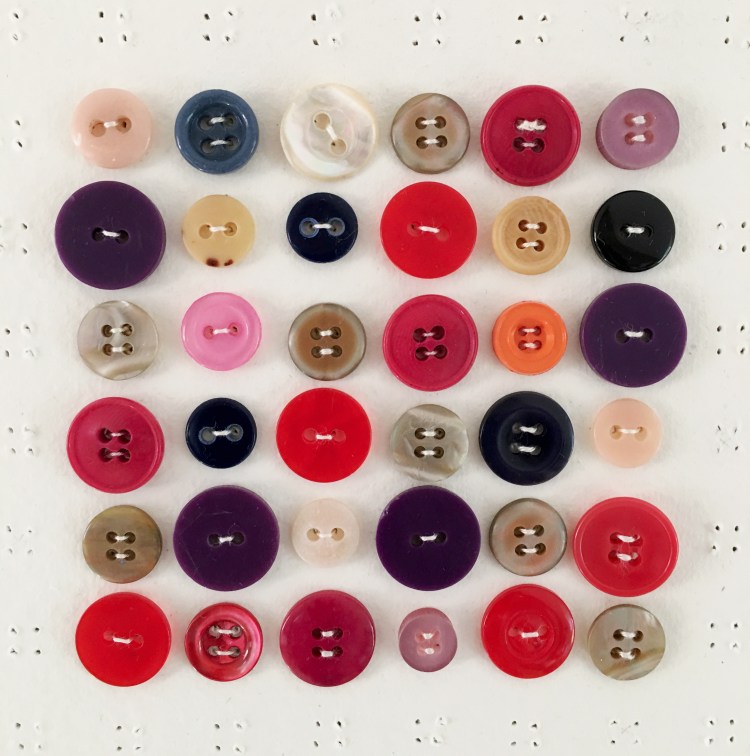

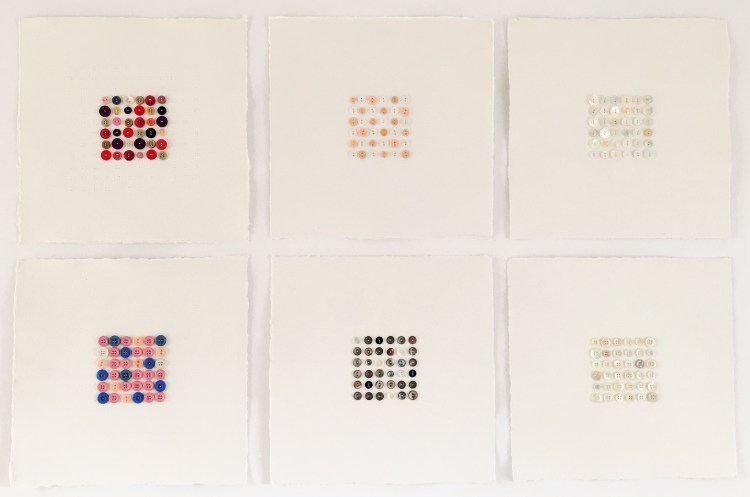
0m64 H x 0m98 W. Photo © Françoise Dupré
 Françoise Dupré